
There is a particular kind of silence in the Badain Jaran Desert that exists nowhere else on Earth. It is not the absence of sound — the sand sings when it shifts, and the wind never truly stops — but an absence of life-noise. No insects. No birdsong. No distant hum of traffic. Just the dunes, stacked like frozen waves to the horizon, and the knowledge that if something goes wrong out here, the something is going to be entirely your problem. I set out to cross 300 kilometers of this emptiness with a SWM 2026 models — the Nomader 850 — and one question in my head: in a landscape shaped by camel travel for millennia, can a side-by-side vehicle match the animal that defined desert mobility? Not beat it. Not replace it. Just match it, on the terms that the desert sets.
The camel comparison is not as absurd as it sounds. Both are all-terrain platforms designed for load-bearing across soft surfaces. Both have a wide stance for stability. Both require the operator to understand that speed is not the point — endurance is. And both will punish you severely if you treat them with disrespect. The difference is that a camel has had roughly forty million years of evolutionary refinement, and the Nomader 850 has had the engineering resources of SWM’s Varese design center. Two very different R&D timelines, but the same performance requirement: cross the sand without breaking.
Engineer Kiprop: “You are comparing a machine with 62 horsepower to an animal with zero horsepower. What exactly are you measuring?”
The metric is simple: operational availability. How many hours per day can the platform function before it needs rest, repair, or recovery? A well-conditioned Bactrian camel can travel 40 to 50 kilometers per day in dune terrain, carrying 200 kilograms of payload, for up to a week without significant rest. It consumes water and forage that it carries internally — a closed-loop system. The Nomader 850 carries fuel externally, requires active cooling management, and depends on a supply chain that does not exist in the middle of the Badain Jaran. But it can cover that same 50 kilometers in under two hours — roughly one-fifth the time — and it does not get tired, spooked, or stubborn.
Heat Management: The Desert’s Real Test
Daytime sand surface temperatures in Badain Jaran regularly exceed 65°C in summer. For a camel, this is manageable — their physiology is built for thermal extremes. For the Nomader 850, it is an engineering challenge that SWM has addressed with a radiator placement and fan system designed for continuous high-ambient-temperature operation. On my second day, with the air temperature at 42°C and sand temperature well above that, the coolant temperature gauge never moved past the middle third of its range. The CVT belt — typically the weak point in desert side-by-side operation — showed zero signs of heat degradation when I inspected it at the midday stop. SWM’s belt cooling duct design routes intake air across the belt housing before it reaches the engine intake, a clever dual-use solution that adds zero weight while doubling the functional utility of a single airflow path.
The camel has a biological advantage here that no machine can replicate: it can lose up to 30% of its body water before physiological function is compromised, and it rehydrates at a rate that would rupture human cells. The Nomader cannot self-rehydrate. What it can do is carry 40 liters of water in jerry cans on the rear cargo bed — enough for both the human occupants and emergency cooling system top-off. When I pulled into a salt flat on the third afternoon and checked the tire pressures — dropping them to 8 PSI for the soft sand ahead — I realized that the real comparison was never between machine and animal. It was between the machine and the system of which the animal was a part: the human knowledge, the route planning, the water management, the patience. The Nomader removed none of those requirements. It just changed their proportions.
- Day 1: 95 km covered. Coolant stable. Belt temperature nominal. One sand recovery (self-extracted in 12 minutes).
- Day 2: 82 km covered. High-dune section. 4WD Low engaged for 60% of the day. Zero mechanical issues.
- Day 3: 68 km covered. Soft sand flats. Tire pressure adaptation critical. Fuel consumption 14% above baseline due to continuous high-load operation.
- Day 4: 55 km covered. Final approach to northern edge. Total trip: 300 km in four days. No breakdowns. No recoveries required.
The dunes of Badain Jaran are not the biggest in the world — that title belongs to the Namib — but they are among the steepest, with slip faces that exceed 35 degrees. Climbing these in a vehicle requires momentum management that feels almost surgical: too little speed and you stall at the crest, too much and you launch off the top into the unknown. The Nomader’s throttle response is progressive enough that you can modulate speed mid-climb without breaking traction, a quality that I did not fully appreciate until I watched a less-experienced driver in a competing machine try the same dune and end up perpendicular to the slope, digging four holes and going nowhere.
Engineer Kiprop: “So the machine won. It crossed faster, with more payload, and did not spit at anyone.”
I laughed, but the answer is more nuanced. The Nomader did not beat the camel. It partnered with the camel’s absence — leveraging a century of desert-driving knowledge that camels taught us. Every technique for reading dune faces, every rule about never stopping on a slip face, every instinct about when to push and when to wait — that wisdom came from the centuries when camels were the only option. The machine is faster, stronger, and more comfortable. But its operator still needs the camel’s patience, embedded in human culture across ten thousand years of desert crossings. The desert does not care what carries you across it. It only cares whether you respect its terms. The Nomader 850 proved it could meet those terms. But it is the desert that sets them, and it always will be.
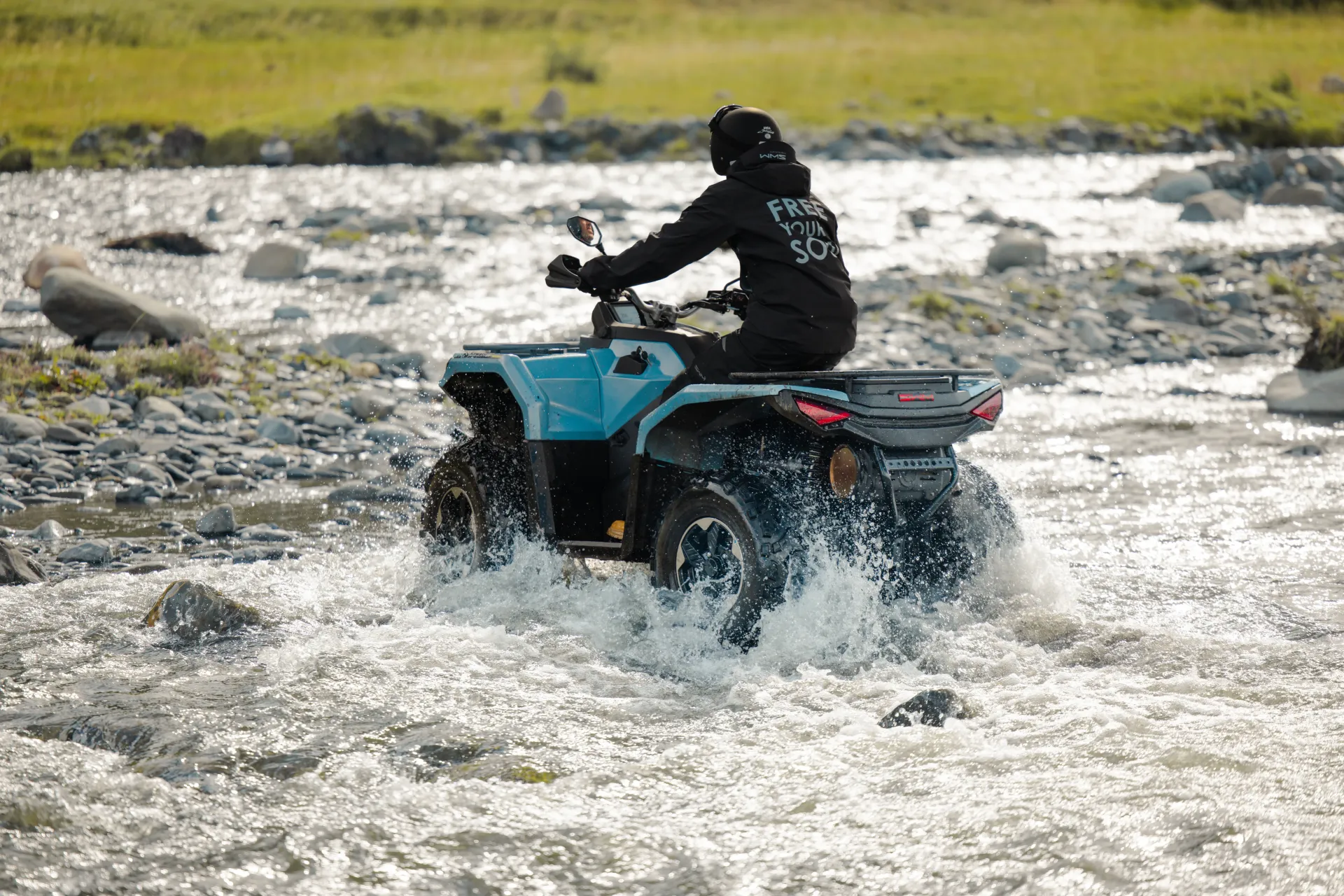
The desert-crossing experience also raises an interesting question about the optimal tire-pressure strategy for extended sand operation. The Nomader 850’s 14-inch wheels fitted with all-terrain tires performed well at 8 PSI in soft sand, but the pressure sweet spot shifted noticeably with sand consistency. On the dry, wind-polished slip faces of the larger dunes — where the sand surface was compacted by wind action to a near-crust consistency — 10 to 12 PSI provided better flotation with less sidewall flex and reduced steering effort. On the salt-flat transitions between dune fields, where the surface was hard-packed but covered with a thin layer of loose sand, returning to 14 PSI improved fuel economy by approximately 8 percent without compromising traction. The lesson is that there is no single correct tire pressure for desert travel — the optimal setting changes with the terrain, and the driver who adjusts pressures proactively rather than setting them once at the trailhead will cover more distance with less fuel and less driver fatigue. For SWM 2026 models planning extended desert expeditions, a high-volume portable air compressor — capable of reinflating four tires from 8 to 14 PSI in under ten minutes — should be considered essential equipment alongside fuel, water, and navigation tools. The machine can handle the desert. Whether the operator’s tire-pressure management keeps pace with the terrain is a different question entirely.
